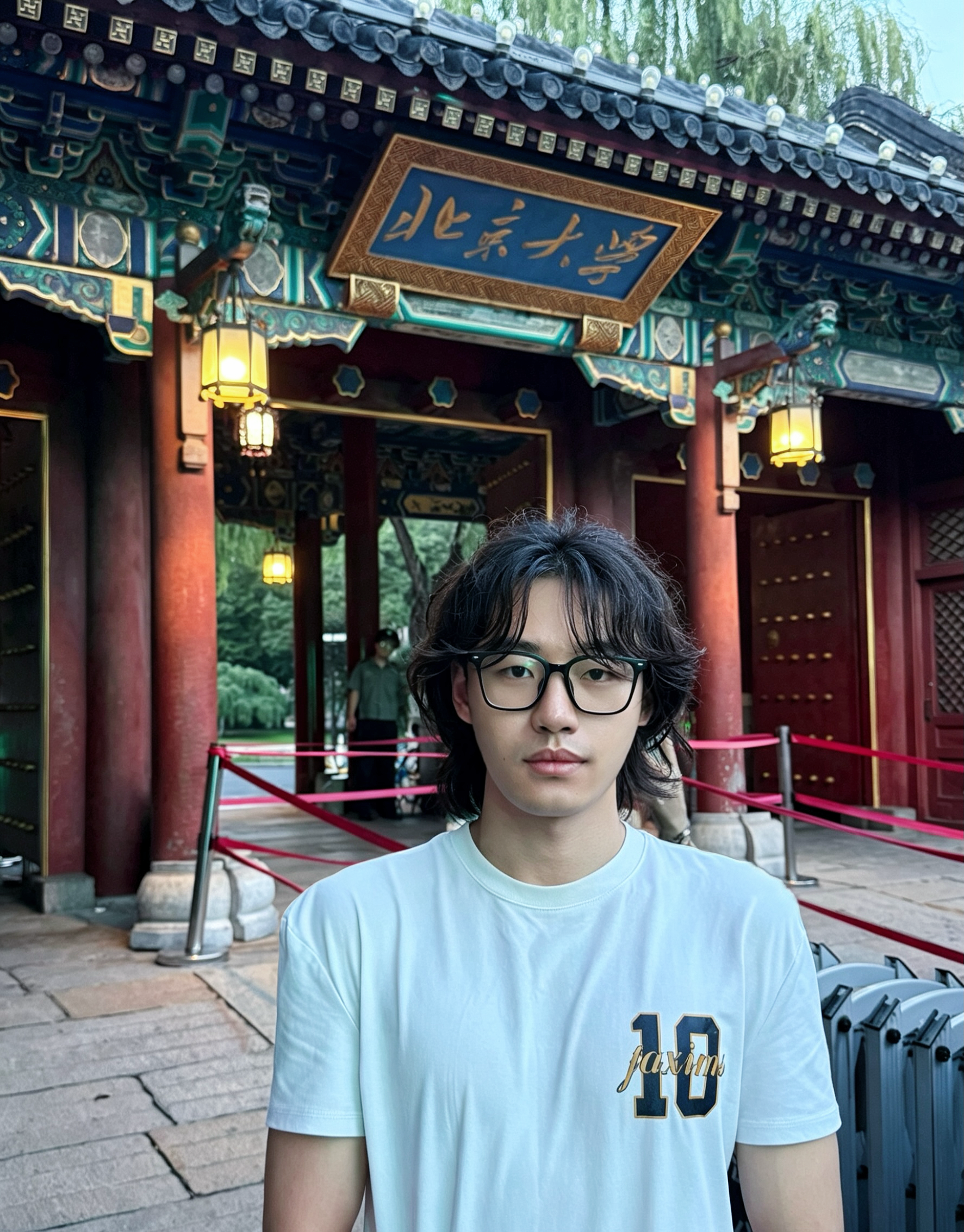
Hi! I’m Lei Liu (刘磊), a senior at Arcadia University pursuing a double major in Mathematics and Computer Science. My research focuses on trustworthy machine learning for healthcare and scientific discovery. My goal is to build the next generation of agents and large language models that are not just capable, but causally grounded and trustworthy enough to be genuinely deployed in high-stakes clinical treatment and biological research. In particular, I work on:
- Uncertainty Quantification: knowing when an LLM’s answer can be trusted, especially in retrieval-augmented generation (GALA).
- Causal Inference for Clinical Data: turning unstructured clinical notes into confounders for reliable treatment-effect estimation (MLHC 2026).
- GUI / LLM-based Research Agents: agents that reproduce, operate, and extend scientific methods and software for clinical and biomedical discovery (LabAgent, OSWorld-Science, MERID).
I’m fortunate to be advised by Prof. Xiao Luo at the University of Wisconsin–Madison and Prof. Hongyu Zhao at Yale University, and co-advised by Prof. Tianyu Liu at Tsinghua University. I am actively looking for a PhD position starting in Fall 2027 — feel free to reach out!
🔥 News
- Nov 2026: 🏅 Received an NIH Travel Grant from Johns Hopkins University to present our MLHC 2026 paper!
- Oct 2026: 🎉 MERID was selected for an oral presentation at the 2nd Beijing Tsinghua Medical AI Forum (BEIHAI Summit)!
- Oct 2026: 📰 OSWorld-Science was featured by Synced (机器之心)!
- Oct 2026: 🏅 LabAgent received a Registration Award from the 19th PQG Conference! Presenting a poster at Harvard, Oct 29–30.
- Sep 2026: 📄 MERID is now on arXiv!
- Sep 2026: 🚀 OSWorld-Science is out on arXiv — check out the project page!
- Sep 2026: 📄 LabAgent is now on arXiv!
- Jul 2026: 🎉🎉 One paper accepted to MLHC 2026! See you at Johns Hopkins Hospital in Baltimore.
📝 Publications & Manuscripts
LLM-Extracted Covariates for Clinical Causal Inference: Rethinking Integration Strategies
Lei Liu, Jialin Chen, Kathy Macropol
Machine Learning for Healthcare (MLHC) 2026
🏅 NIH Travel Grant, awarded by Johns Hopkins University to present this work at MLHC 2026.
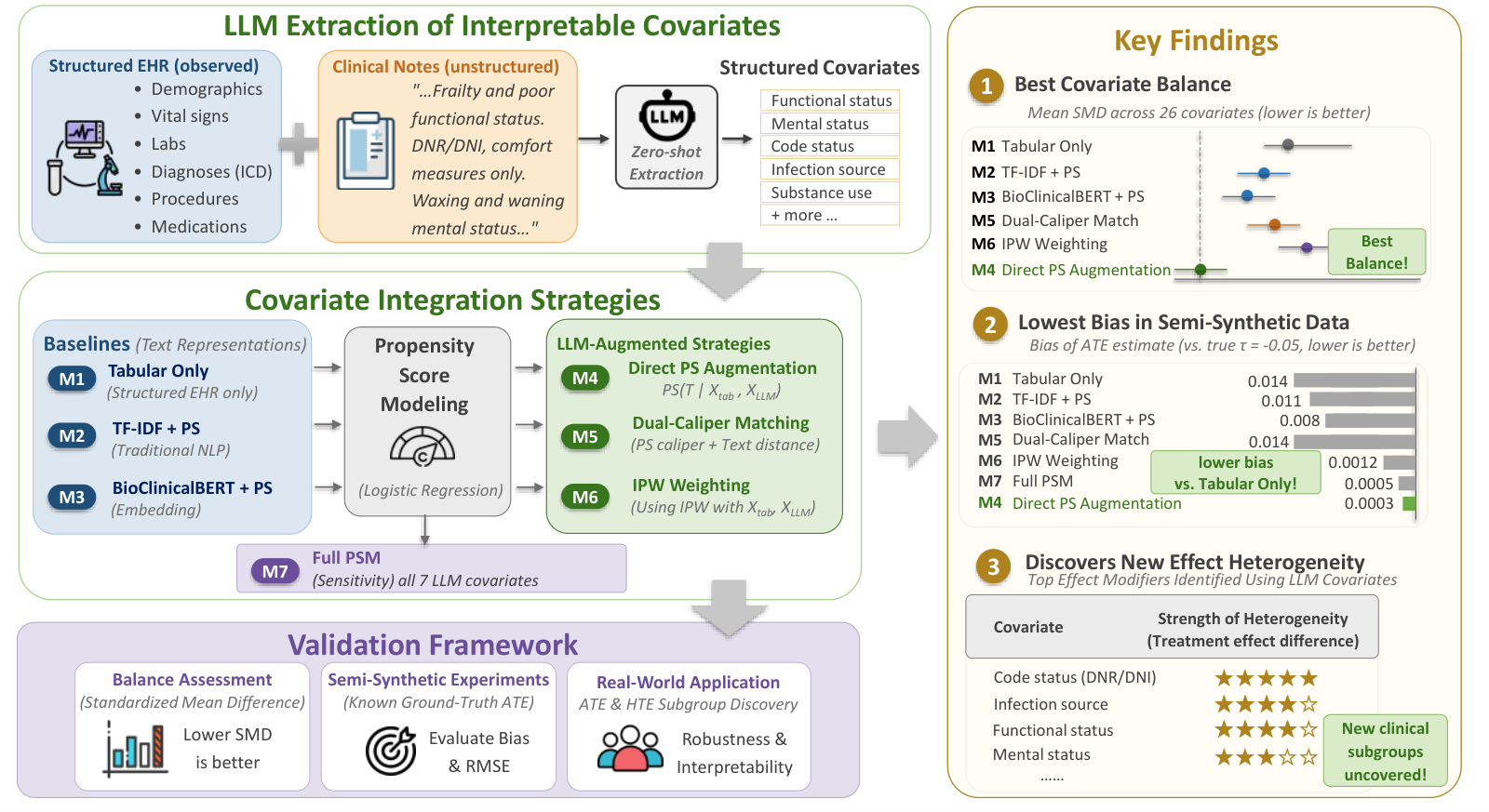
Folding LLM-extracted confounders from clinical notes into the propensity model substantially revises sepsis treatment-effect estimates on 21,859 MIMIC-IV patients.
Read moreShow less
We study how to integrate LLM-extracted clinical covariates into causal inference. On a MIMIC-IV Sepsis-3 cohort of 21,859 patients, we compare seven covariate-integration strategies and show that augmenting the propensity model with LLM-extracted confounders (functional, mental, and code status from free-text notes) substantially revises effect estimates — directionally consistent with the CLOVERS RCT and robust under a doubly-robust AIPW estimator.
LabAgent: Customize Any Research Hubs for Scientific Discoveries Using AI Agents
Lei Liu, Yikun Zhang, Jialin Chen, Wanjia Zhao, Rex Ying, Wengong Jin, Hua Xu, James Zou, Tianyu Liu, Hongyu Zhao
Under Review at Nature Machine Intelligence
🏅 Registration Award, 19th PQG Conference — poster presentation at Harvard, Oct 2026.
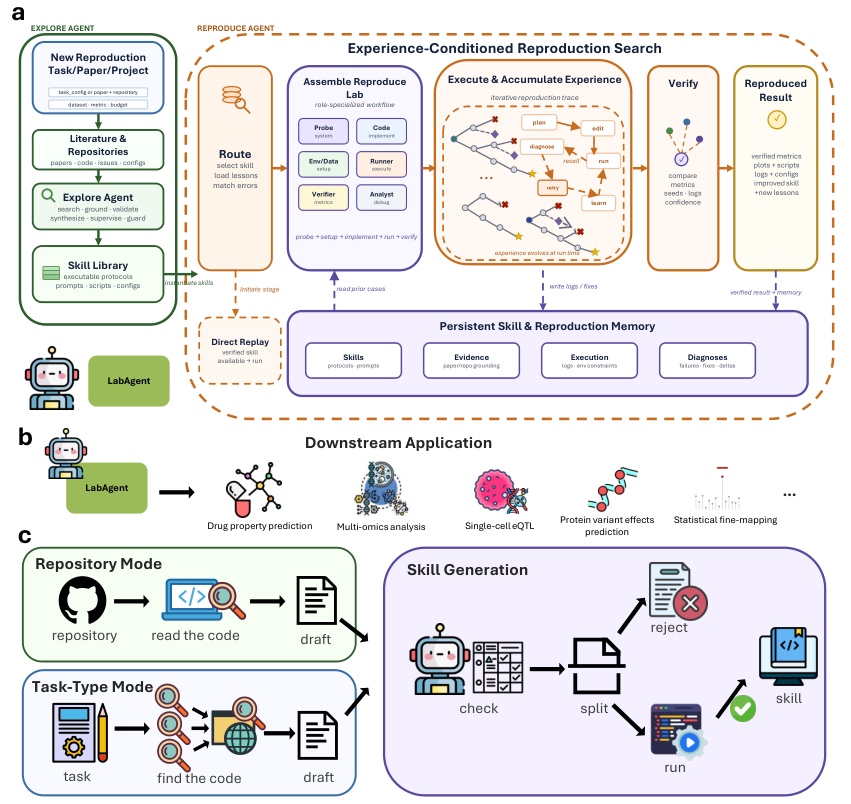
Turns a lab’s papers, code, and tutorials into reproduction-verified executable skills, so AI agents can both reproduce and extend published biomedical methods.
Read moreShow less
We introduce LabAgent, a reproduce-and-discover framework that turns a lab's papers, code, and tutorials into executable skills, admitting a skill only after it reproduces published results and recording failure-and-repair experience so later runs avoid the same errors. Across drug property prediction, biomedical data analysis, protein variant effect prediction, and statistical genetics, LabAgent both reproduces published methods and composes them into new solutions — reaching a mean Spearman correlation of 0.443 across 13 ProteinGym assays and the highest BiomniBench-DA process score (74.4) among evaluated agent baselines.
OSWorld-Science: A Benchmark of Computer Use Agents for Learning and Using Scientific Software
Dingyuan Dai*, Heli Qi*, Lei Liu*, Yinxi Li*, Baiding Chen*, Zijun Dou*, Qingcheng Zeng, Qi Kang, Oliver Sun, Eric Wang, Bo Zhou, Haixin Wang, Yufan Du, Shi Bo, Ruihan Lin, Mengqi Yuan, Dunjie Lu, Steven Dillmann, Yiming Shi, Tina Su, Amy Xin, Minghao Liu, Xi Wang, Xu Huang, Ge Zhang, Pengyu Nie, Zhen Yang, Jie Tang, Juanzi Li, Weihao Xuan, Tianyu Liu*
* Equal contribution (co-first authors)
Technical Report
📰 Featured by Synced (机器之心).
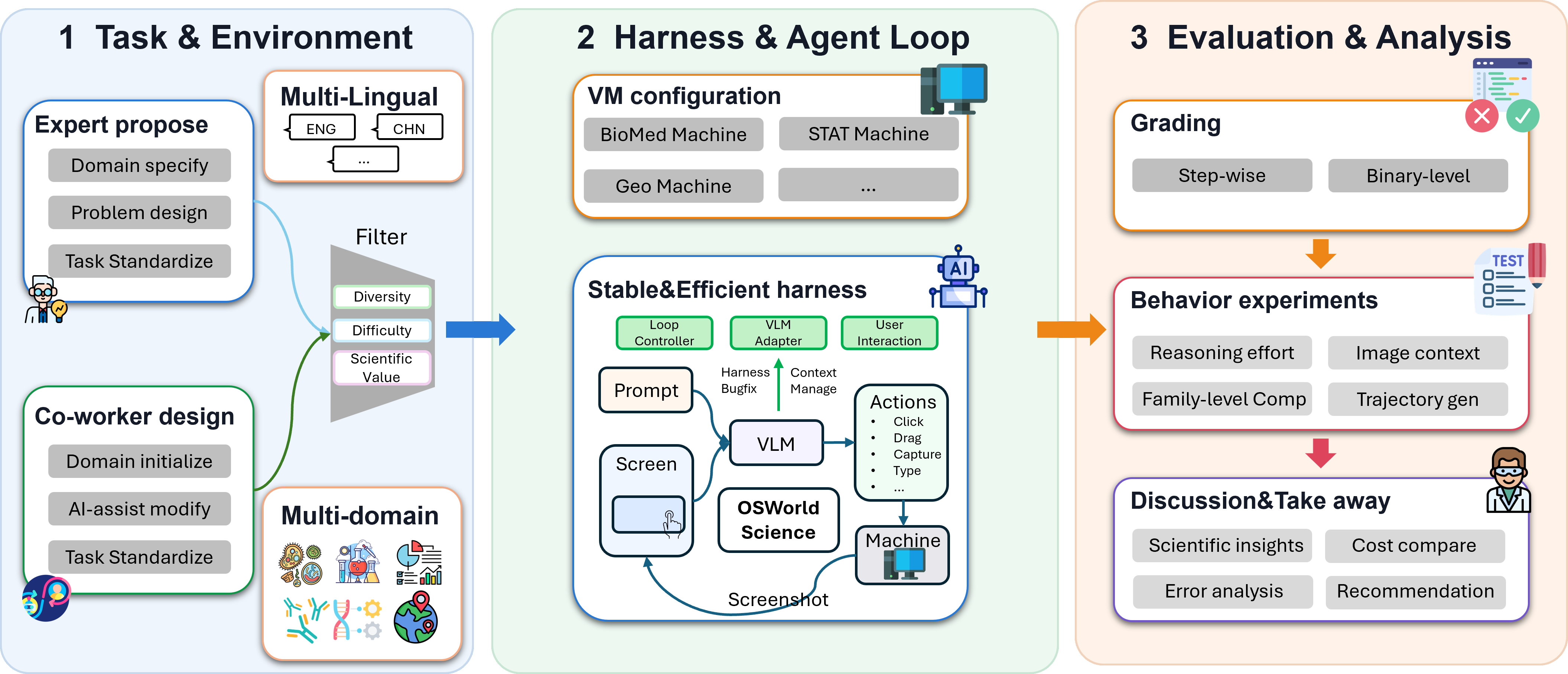
OSWorld-Science is a benchmark for computer-use agents that learn and operate real scientific software, extending the OSWorld setting to the tools that day-to-day scientific work actually runs on.
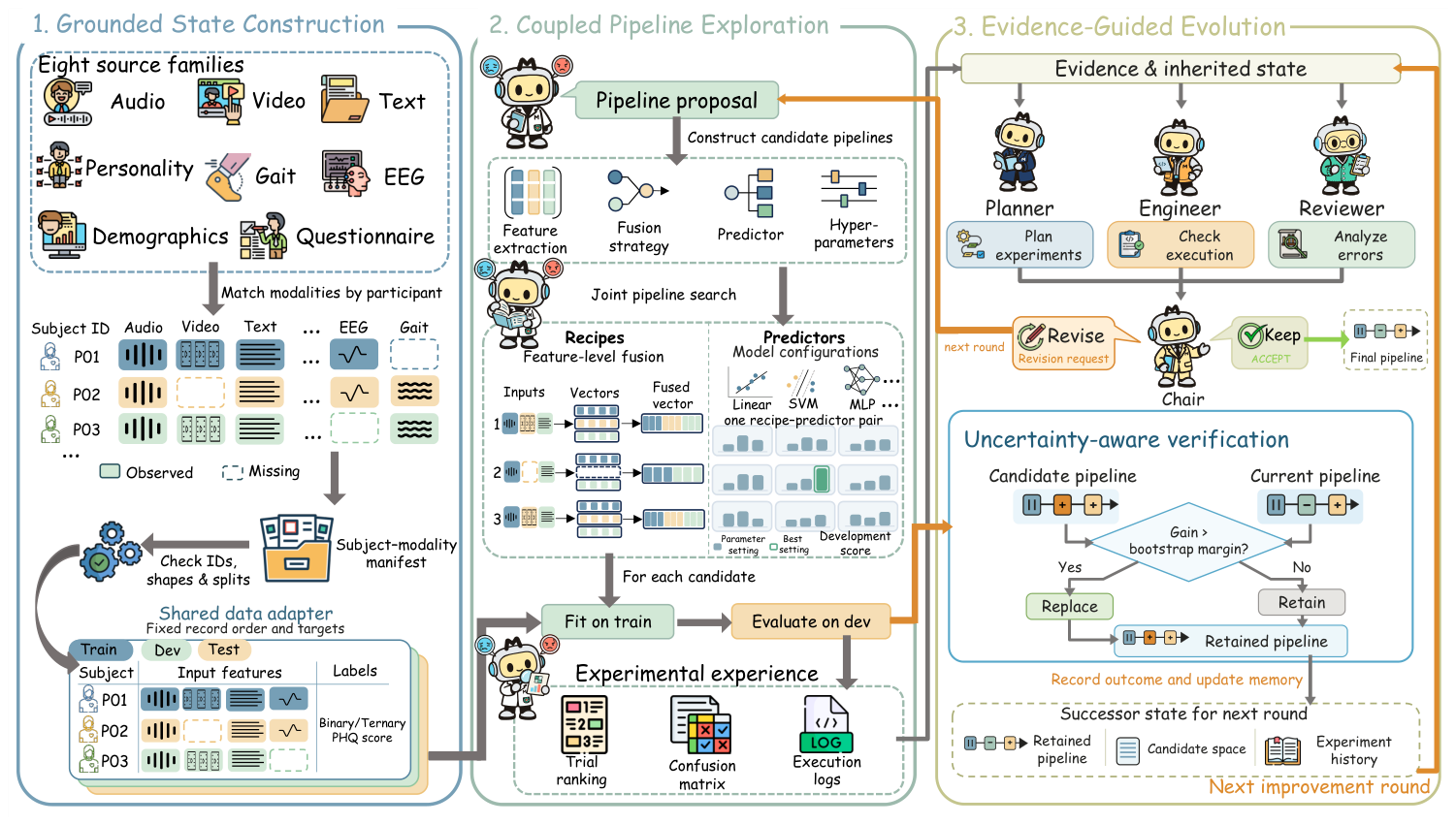
MERID: Multimodal Exploration via Recursive Self-Improvement Agents for Major Depression Analysis
Lei Liu*, Zhaokang Liang*, Qingcheng Zeng, Chenda Duan, Lu Mi, Zhen Tan, Tianyu Liu
* Equal contribution (co-first authors)
Under Review
🎉 Oral Presentation, 2nd Beijing Tsinghua Medical AI Forum (BEIHAI Summit), 2026.
A recursive self-improving multi-agent system that autonomously searches over features, modalities, and learners for major depression detection.
Read moreShow less
We present MERID, a recursive self-improving multi-agent system for major depressive disorder detection that autonomously searches over feature representations, modalities, learners, and calibration rules. Selection criteria based on cross-fold stability and modality contribution guide the agents' self-evolution, with evaluation on depression datasets including E-DAIC and MPDD-2025/2026.
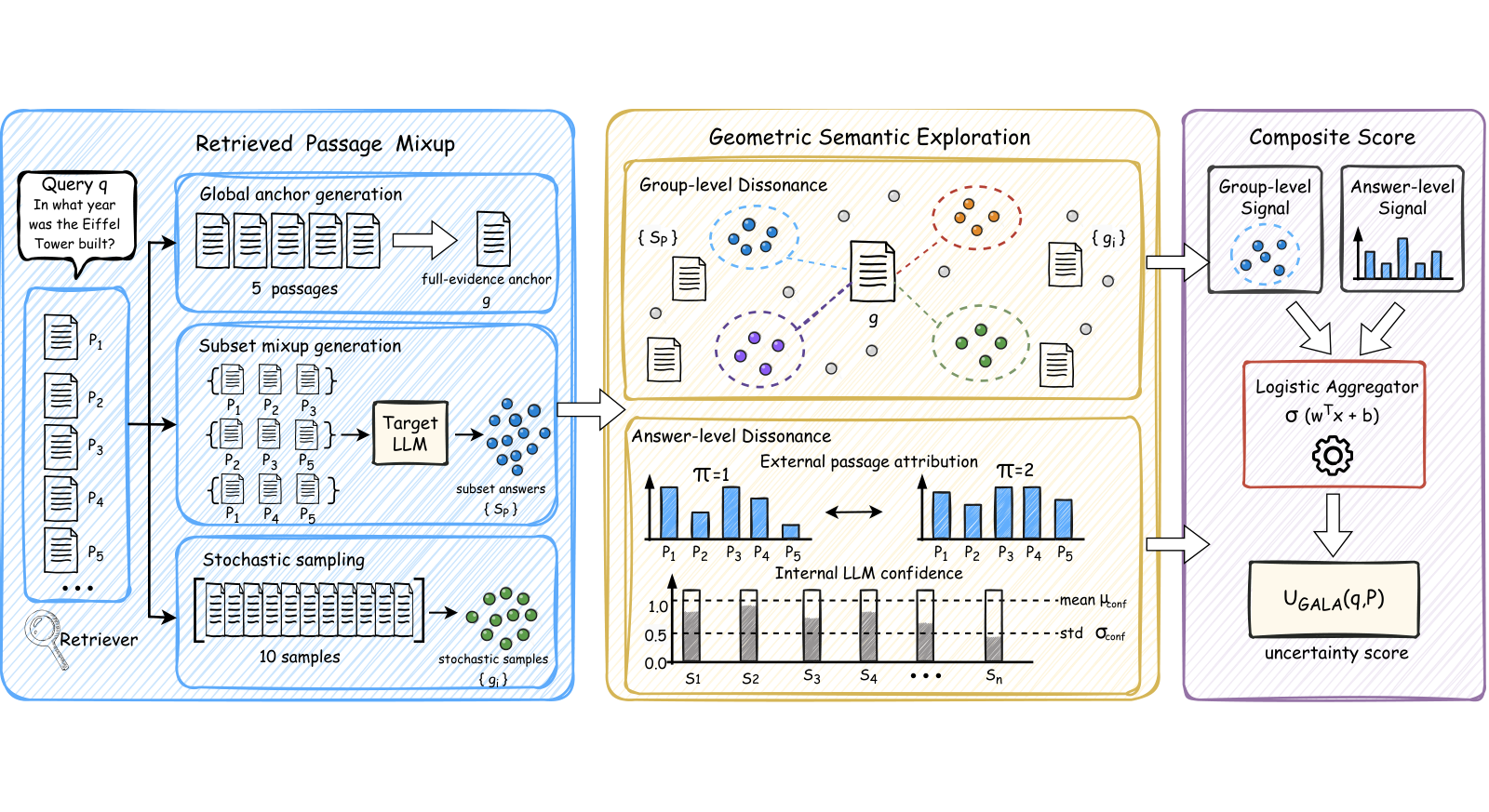
Geometric Semantic Exploration with Passage Mixup for Uncertainty Quantification in RAG
Lei Liu, Yu Wang, Hang Zhou, Xiao Luo
Under Review
Estimates when a RAG answer can be trusted by probing the geometry of its semantic answer space with passage mixup.
Read moreShow less
We propose GALA, an uncertainty-quantification method for retrieval-augmented generation that estimates answer reliability by exploring the geometry of the semantic answer space, using a passage-mixup augmentation to probe answer sensitivity. GALA reaches 0.85 average AUROC on Llama-3.1-8B, outperforming semantic-entropy and passage-utility baselines across six open-domain QA benchmarks.
📖 Education
- Sep 2025 – May 2027 (expected), Arcadia University — B.S. in Mathematics and Computer Science. GPA 3.98/4.00
- Jul 2026 – Aug 2026, Peking University (Summer School Exchange Student) — Instructor: Prof. Tiejun Huang
- Sep 2023 – Jun 2025, Jiangsu University (2+2 Joint Program with Arcadia University) — B.S. in Mathematics and Applied Mathematics (expected Jun 2027). GPA 4.34/5.00 (WES 3.92/4.00)
🔬 Research Experience

Yale University · Research Intern May 2026 – Present
Advised by Prof. Hongyu Zhao; co-advised by Prof. Tianyu Liu (Tsinghua University).
Focus: Research agents for scientific discovery, multimodal mental-health modeling, and computer-use agents for science.
Part-time, Sep 2026 – Present: an AI-hospital benchmark for continual learning; MindCare, a Qwen3-Omni mental-health world model on UK Biobank and MIMIC-IV (manuscript in preparation); OSWorld-Science V2.0.
Full-time, May – Aug 2026: LabAgent (first author, under review at Nature Machine Intelligence); MERID (co-first author, oral at BEIHAI Summit); OSWorld-Science (co-first author, technical report).

University of Wisconsin–Madison · Research Intern (part-time) Jan 2026 – Present
Advised by Prof. Xiao Luo.
Focus: Uncertainty quantification for retrieval-augmented generation.
Work: GALA (first author, under review).

Nanyang Technological University · Research Intern (part-time) Jul 2025 – Sep 2025
Advised by Prof. Xinfeng Li.
Focus: Permission safety of GUI / computer-use agents under prompt-injection attacks.
Work: an OSWorld-based testbed measuring permission violations of commercial and open-source GUI agents.
Clinical Causal Inference · Project Leader May 2025 – Mar 2026
National-Level College Students’ Innovation and Entrepreneurship Program. Advised by Prof. Kathy Macropol (Arcadia University).
Focus: Integrating LLM-extracted covariates into clinical causal inference.
Work: LLM-Extracted Covariates (first author, MLHC 2026; NIH Travel Grant).
🎖 Academic Services
- Conference Reviewer: ML4H 2026, WSDM 2027
🏆 Honors & Awards
- 2026 E2B for Startups Program ($20,000 in credits), as founder of Twinward AI
- 2025 – 2026 Dean’s Distinguished Honor List, Arcadia University (Fall 2025, Spring 2026)
- 2025 Presidential Award, Arcadia University ($56,000 total)
- 2025 National Second Prize, National University Student Statistical Modeling Competition (top 0.9%)
- 2025 National Innovation and Entrepreneurship Project Funding, Ministry of Education (CNY 8,000)
- 2024 Silver Medal, Chinese Mathematical Olympiad for University Students
- 2024 National First Prize, Chinese Undergraduate Physics Experiment Competition (CUPEC, top 3%)